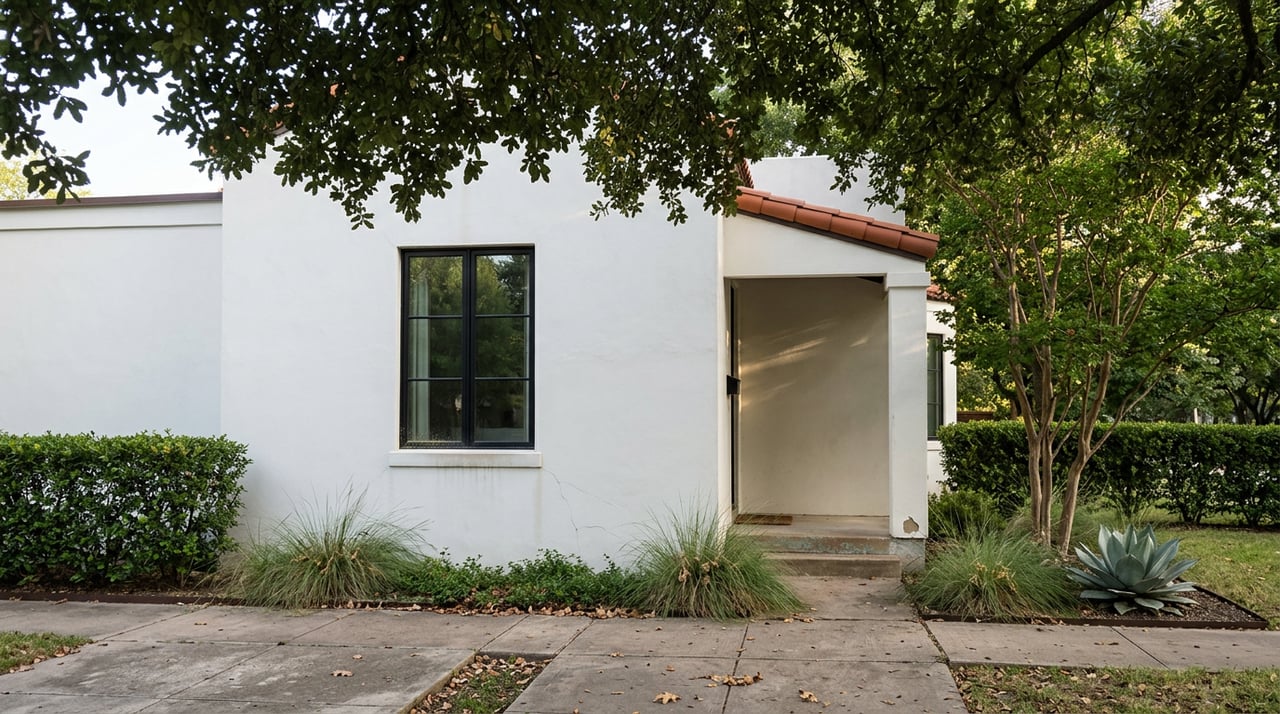
A retail block on West 6th changed hands. If you follow Austin commercial real estate even loosely, you probably saw the notice: West Side Village, the two-story strip at 1214 and 1312 West 6th Street, sold after a bidding process that drew more than 20 offers. CBRE brokered the deal for the sellers, a joint venture between Stonelake Capital Partners and Schlosser Development. The buyer was Riverside, an Austin-based investment firm. On paper, that reads like a corridor in flux.
Walk the four blocks between West Lynn and Blanco and you'll find something closer to the opposite. The building changed ownership. The neighborhood did not particularly notice.
The building that sold has a familiar tenant inside it
Here's the detail that makes the sale less dramatic than it sounds: the retail space at 1214 West 6th, the same address named in the CBRE release, is currently home to Westside Market, the multi-brand concept from the ByGeorge team. Maggie Fox, a longtime member of ByGeorge and co-owner of Filth Mart, led the buildout after ByGeorge closed its South Congress location. The 10,000-square-foot space opened as a home for fashion, food, art, and design under one roof, and it was never a chain parachuting into Clarksville from somewhere else. It's Austin retail people, moving three miles across town and reopening under a new name.
So the ownership of the building changed. The people running the space that actually touches your daily walk down West 6th did not.
What hasn't turned over on West Lynn
If you want to see how little the neighborhood's actual anchors move, walk one block over to West Lynn Street. Jeffrey's has been serving upscale American food from the same historic Clarksville house since 1975. Its sister restaurant, Josephine House, sits a few doors down in a small blue cottage at the corner of Waterston and West Lynn, with the same shaded patio and grassy front lawn it has had for years, open for breakfast straight through dinner. Cipollina, the neighborhood's Italian restaurant and market, is on the same street.
Not everything on that stretch survived. Nau's Enfield Drug, the soda fountain on West Lynn that had been serving the neighborhood since the early 1950s, closed for good in 2023 after seven decades. That closure belongs on this list too, not glossed over, because a neighborhood that never loses anything isn't a real neighborhood. It's a museum.
Here's how the two corridors actually compare when you line them up:
| West 6th (commercial spine) | West Lynn (restaurant row) |
|---|---|
| West Side Village building sold to a new owner | Jeffrey's, open since 1975 |
| Westside Market opened under a new name in 2025 | Josephine House, same cottage, same patio |
| Retail leasing cycles turn over every few years | Cipollina, still the neighborhood's market and kitchen |
| One long-running fixture, Nau's Enfield Drug, closed in 2023 | Clark's Oyster Bar, open at Sixth and Blanco since 2012 |
Clark's deserves its own line, since it sits right at the seam between the two corridors. It opened in 2012 in the Old West Austin neighborhood near downtown and has held the same marble oyster bar and tree-shaded deck ever since. Fourteen years on the same corner is a long tenure for a restaurant anywhere in Austin, long enough that most people who moved to Clarksville after 2015 have never known the intersection without it.
The park runs on its own calendar
If West 6th is where the neighborhood's commercial energy shows up, Pease Park is where its actual rhythm lives, and that rhythm barely shifts year to year. The Pease Park Conservancy runs a steady rotation of small, recurring volunteer mornings in Kingsbury Commons: Off the Trail Tuesdays, Weeding Wednesday, and Loving Lamar Thursday, each open to anyone 13 and up. None of these are new. They are the kind of unglamorous, repeat every week programming that only shows up on a calendar if you're already checking it, which is exactly the point.
The park's bigger annual moments follow the same pattern of showing up right on schedule rather than reinventing themselves. This year's Pride Picnic, a partnership between Pease Park Conservancy and Future Front Texas, ran its fifth consecutive year on June 27 in Kingsbury Commons, with a rainbow ribbon cutting at 12:30 that also marked the Conservancy's new membership in the Austin LGBT Chamber of Commerce. It's the same three food trucks that anchor the park every year: El Mariachi's Tacos, Snoride ATX for snow cones, and Brother Friend Coffee.
And the park's oldest tradition predates almost everything else on this list. Eeyore's Birthday Party has run every year since 1963, founded by UT students and faculty on the last day of April to mark the start of spring. The Troll Sculpture and the Observatory Treehouse have become the park's unofficial landmarks, the kind of thing you point out to a visitor without thinking about it. And if you walk dogs off leash, you already know the stretch between 24th and 29th Streets is the one part of the park where that's actually allowed.
The neighborhood's older clock
None of this is new information if you've lived here more than a year, but the timeline is easy to lose track of: Clarksville itself was founded in 1871 by a freedman named Charles Clark, making it one of the oldest surviving settlements of its kind west of the Mississippi. The historic district was added to the National Register of Historic Places in 1976, and the Clarksville Community Development Corporation still operates out of the Pauline Brown Clarksville Neighborhood Center, built in 1978 at 1807 West 11th Street. Even Whole Foods traces its roots back to this stretch of Austin. The original Clarksville Natural Grocery opened in 1979, and a year later its founders joined forces with John Mackey to open the first Whole Foods Market under that same original name.
A neighborhood with that kind of founding date doesn't move at the speed of a commercial real estate cycle. It moves at the speed of the institutions that outlast whoever happens to own the building on the corner.
What this actually tells you
The lesson here isn't that nothing changes in Clarksville. Buildings sell, tenants rotate, and a beloved soda counter can close after 70 years. But the retail spine on West 6th operates on a real estate clock, measured in lease terms and ownership transfers, while the places that actually define a week here, Jeffrey's on a Friday night, the volunteer morning at Kingsbury Commons, the dog stretch along Shoal Creek, run on a much longer and much slower one. If you're reading "for lease" signs or a property transfer as a signal that the neighborhood itself is turning over, you're reading the wrong clock.
If you're weighing what a home in a neighborhood like this is actually worth to you day to day, that distinction matters more than most people realize. Bridget Ramey works this exact stretch of West Austin and can walk you through what's genuinely changing here and what's simply changed hands. Schedule a private consultation to talk through it.