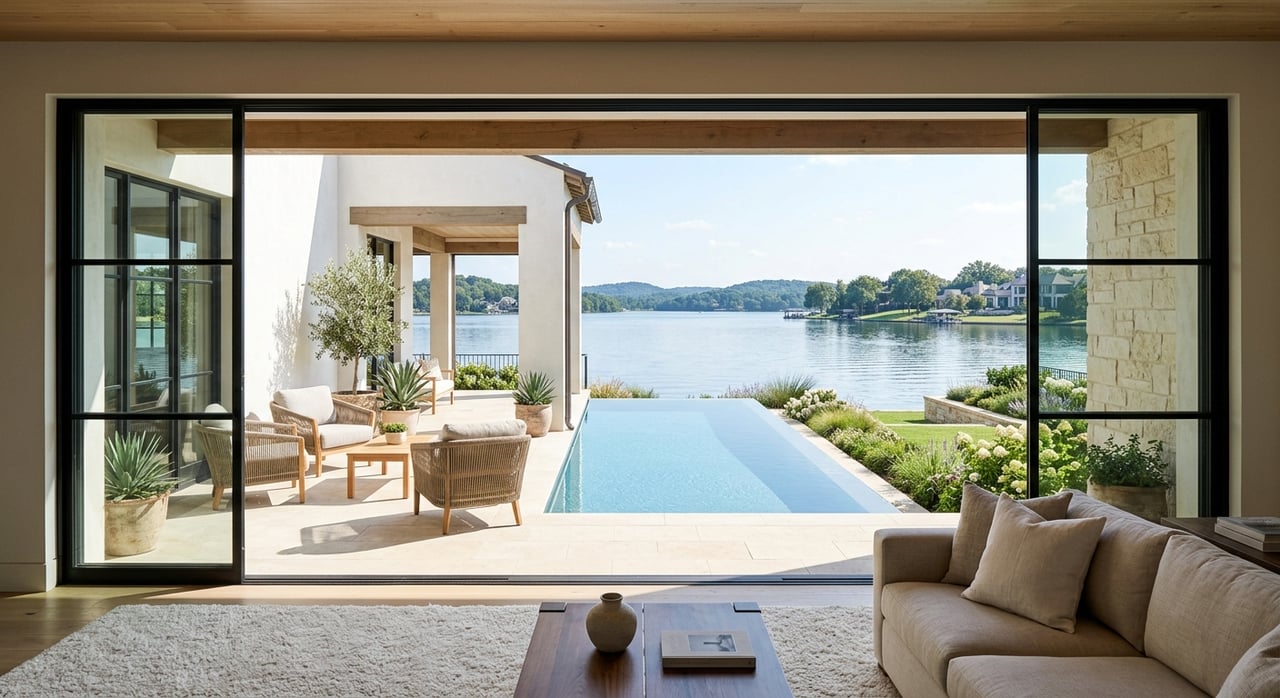
If you picture Lake Austin living, you probably picture more than a beautiful house. You picture mornings with water views, afternoons that move easily from kitchen to terrace, and evenings that end by the pool, on the dock, or under a covered outdoor lounge. On Lake Austin, the best homes are not just designed to face the water. They are designed to live with it. Let’s dive in.
Why Lake Austin design feels different
Lake Austin has a very specific rhythm, and that shapes what works in a home. The lake is a 20.25-mile reservoir on the Colorado River, and the Lower Colorado River Authority notes that it is a constant-level lake, though water levels can shift slightly with upstream releases. The shoreline is also heavily defined by boat docks, which makes views, access, and outdoor gathering space especially important.
Climate matters just as much as the view. Austin’s humid subtropical weather brings long, hot summers, with more than 100 days above 90 degrees, along with periods of thunderstorms, flash flooding, hail, and wind damage, according to the City of Austin climate report. That means seamless indoor-outdoor living on Lake Austin is not only about style. It is about shade, airflow, durable materials, and planning for the setting.
Indoor-outdoor living is a luxury priority
This design direction is not a passing trend. Coldwell Banker Global Luxury reports that more than 60% of Luxury Property Specialists rank indoor-outdoor living as a top feature, and its 2025 coverage highlights warm modernism defined by open floor plans, natural materials, and easy flow between inside and outside.
That aligns closely with what buyers often expect in top-tier Lake Austin properties. AD PRO’s 2025 outdoor forecast notes that outdoor areas are increasingly expected to function as a second living room, entertaining zone, or wellness-oriented retreat. Houzz research adds that 33% of homeowners improving outdoor areas are doing so to extend living space, with durability and aesthetics both ranking as top purchase considerations.
For Lake Austin, that means the strongest homes do not treat the backyard as an afterthought. They create a connected sequence of spaces that feel furnished, intentional, and ready for daily life.
Start with a covered terrace
A covered terrace is often the anchor of a successful Lake Austin indoor-outdoor plan. It gives you relief from the sun while keeping the lake view open, and it helps outdoor living feel usable through more of the year.
Luxury design coverage frequently pairs covered dining and lounge areas with open interiors and patios because the transition feels natural and refined. On Lake Austin, that idea works especially well when interior finishes and colors continue onto the terrace. When the flooring tones, materials, and furniture style feel connected, the lake becomes part of the room rather than something you only look at from inside.
What a strong terrace often includes
- A shaded lounge zone
- A separate dining area
- Ceiling fans for airflow
- Durable furnishings selected for sun and moisture exposure
- Lighting that supports evening use without overwhelming the setting
This is one of the clearest ways to make a waterfront home feel effortless instead of staged.
Use the pool to frame the lake
Pools and water features are often part of the Lake Austin lifestyle, but the best designs work with the site instead of competing with it. In waterfront design coverage, Architectural Digest highlights infinity-edge pools because they visually soften the boundary between built space and the horizon.
On Lake Austin, that same design logic can be especially effective. A well-placed pool can make the lake the visual backdrop, helping the architecture, landscape, and water read as one composition. Instead of pulling attention away from the shoreline, the pool can reinforce it.
Houzz also found that 18% of homeowners upgrading outdoor elements added or improved water features, which shows how strongly water continues to shape luxury outdoor design.
Pool features that support seamless flow
- A pool aligned with primary living spaces
- Deck materials that connect visually with interior finishes
- Lounge areas that do not block sightlines
- Shade structures or umbrellas for comfort during hot months
- Subtle lighting for evening entertaining
Make outdoor spaces feel finished
One of the biggest shifts in luxury design is that outdoor areas are expected to feel complete. They are not just patios with a grill. They are full-use environments that support relaxing, dining, hosting, and day-to-day living.
According to Houzz, common outdoor upgrades include decks, outdoor kitchens, pools, hot tubs, lighting, furniture, and outdoor technology. That matters on Lake Austin because the homes that stand out tend to offer a clear sense of lifestyle. Buyers can immediately understand how the spaces work together.
Outdoor elements that often add cohesion
- Outdoor kitchens near dining and lounge areas
- Layered lighting for paths, terraces, and entertaining zones
- Furnishings scaled to the architecture and view
- Storage that keeps equipment and accessories out of sight
- Materials that look elevated without requiring constant replacement
Think of the dock as social space
On Lake Austin, the dock is often more than a place to tie up a boat. It can also serve as a natural extension of the home’s entertaining and recreation areas. The Texas Parks and Wildlife Department notes that many boat docks line the shore, which reflects how central dock access is to the local lifestyle.
That said, it is important to think about docks in the right way. A dock can absolutely function as a gathering space, but City of Austin rules make clear that it is still a regulated structure. The City states that water-adjacent construction may require reviews and permits, and an approved site plan or exemption is required before a dock permit is issued, as outlined in the City of Austin boat dock guidance.
The City also states in its single-family boat dock and shoreline modification requirements that a business or living quarter may not be built on a pier or similar structure extending into or above Lake Austin unless there is a City Council-approved license agreement. So while a dock can be staged and designed for entertaining, it should not be treated as habitable square footage.
Smart dock design mindset
- Prioritize seating and gathering areas
- Plan for visibility, safety, and circulation
- Use durable finishes that handle sun and water exposure
- Treat the dock as lifestyle space, not enclosed living space
- Confirm feasibility early before investing in design details
Choose materials for heat and moisture
Beautiful design is only part of the equation on Lake Austin. Materials need to perform in heat, sun, humidity, and occasional severe weather.
The U.S. Department of Energy says cool roofs reflect more sunlight and can stay more than 50 degrees cooler than conventional roofs in sunny conditions. DOE also notes that skylights can add unwanted summer heat, and some plastic glazing can admit UV unless treated, which may fade interior furnishings.
For lower levels, terraces, and shoreline-adjacent improvements, flood and moisture resistance also matter. FEMA recommends flood-resistant materials such as concrete, ceramic or clay tile, stone, glass block, metal, pressure-treated or decay-resistant lumber, and cold-formed steel.
Practical material priorities
- Roofing that reduces heat gain
- Exterior finishes that tolerate intense sun
- Hardscape and terrace materials that resist moisture
- Furnishings and surfaces selected for UV durability
- Lower-level materials chosen with water exposure in mind
Even the City’s dock registration rules point to the need for durability, requiring address signage that resists water damage and UV deterioration. That is a useful reminder that on Lake Austin, lasting design is part of good design.
Plan for permitting early
One of the most common mistakes in waterfront design is assuming that every idea is buildable. On Lake Austin, shoreline improvements, docks, and related structures can face more limitations than owners initially expect.
City guidance notes footprint and frontage limits for certain projects, and the LCRA also emphasizes that dock owners must comply with the most restrictive applicable rules, including local jurisdiction and HOA or POA requirements where relevant. In practice, that means your concept, design team, and permitting strategy should work together from the beginning.
Early planning helps you avoid
- Designing features that exceed site limits
- Delays tied to site-plan review or permit approvals
- Overbuilding at the shoreline
- Costly redesigns late in the process
- Confusion about what can be used as living space
The strongest Lake Austin homes balance aspiration with feasibility. When the architect, landscape designer, and permit team are aligned early, the finished result usually feels both elevated and effortless.
What seamless living really means on Lake Austin
At its best, seamless indoor-outdoor living on Lake Austin is not about opening a few big doors and adding patio furniture. It is about creating a home that responds to the lake, the climate, and the way you actually want to live. Covered terraces, well-placed pools, finished outdoor rooms, and thoughtful dock spaces all help shape that experience.
If you are buying, selling, or evaluating a Lake Austin property, design choices like these can play a major role in both daily enjoyment and market appeal. For tailored guidance on Lake Austin homes and waterfront positioning, connect with Bridget Ramey to schedule a private consultation.
FAQs
What makes Lake Austin indoor-outdoor design different from other Austin waterfront properties?
- Lake Austin’s constant-level water, dock-lined shoreline, and hot, humid climate make shade, airflow, durable materials, and dock integration especially important.
What features matter most for seamless indoor-outdoor living on Lake Austin?
- Covered terraces, outdoor kitchens, pools or water features, layered lighting, and furnished outdoor rooms are among the clearest design signals.
What should you know about Lake Austin dock design before building?
- Docks are regulated structures, and City guidance requires permitting steps such as site plan approval or exemption before a dock permit, plus registration and addressing after completion.
Can a Lake Austin dock count as living space?
- No. City requirements state that a business or living quarter may not be built on a pier or similar structure over Lake Austin except under a City Council-approved license agreement.
Which materials are best for Lake Austin outdoor areas?
- Durable, moisture-tolerant, and UV-conscious materials are key, including options FEMA identifies such as concrete, tile, stone, metal, and pressure-treated or decay-resistant lumber.
Why is early permitting so important for Lake Austin shoreline projects?
- Early planning helps confirm what is feasible on your site and can reduce delays, redesigns, and surprises related to frontage, footprint, and shoreline restrictions.